

Does the business need to be on LinkedIn, Facebook, Instagram, TikTok, YouTube and every platform being touted as “the next big thing” before lunch? No. For most businesses, it is better to use two channels well than six channels half-heartedly.
Choosing social media platforms without a plan is like filling a plate that is too small at a buffet: Everything looks relevant, but the result is an unstable pile nobody really wanted. Channel selection should therefore start with what the business wants to achieve, who it needs to reach and what content it actually has the capacity to create.
The goal is not to find one channel that is “best”. The goal is to choose a combination that supports the customer journey, can be managed over time and provides a sensible path onward to the website, online store, an event or direct contact.
Start with the task, not the platform
The first question should be: What should social media do for the business? “Create visibility” is too vague to guide channel selection. Instead, define the task more precisely.
- Build professional credibility: Share analyses, experience, customer cases and assessments.
- Create demand: Make more people aware of a problem and show how the business solves it.
- Recruit: Show the work environment, professional community, vacant positions and how the work is actually carried out.
- Drive sales: Present products, campaigns and use cases with a clear path to purchase.
- Provide customer service: Answer questions and handle enquiries where customers expect to find you.
- Maintain relationships: Stay in touch with existing customers, members or partners.
One channel can support several tasks, but it should have a primary role. If every piece of content is supposed to build the brand, sell, recruit and celebrate the summer party at the same time, the post often ends up as a PowerPoint presentation with a pulse.
Also define the desired next step. Should the recipient read an expert article, sign up for a webinar, visit a product page or send a message? Social media is often a touchpoint, not the entire customer journey. The website should take over when users need details, documentation, prices or a form that will not disappear into a messaging inbox.
Evaluate each channel against four consistent criteria
Avoid choosing a channel because a competitor is there or because someone has heard that the algorithm “rewards authenticity”. Such claims are the online industry’s equivalent of weather signs: interesting, but weak as a basis for budgeting.
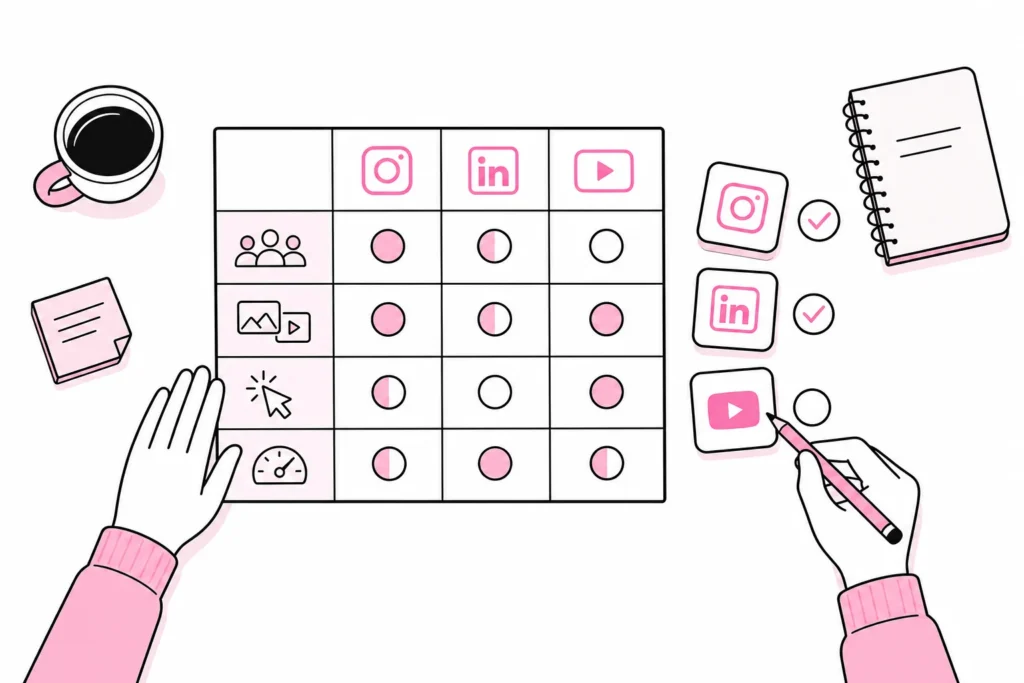
Instead, create a simple evaluation matrix. Give each relevant channel a score from one to five in the following areas:
1. The target audience is present in the right context
It is not enough for the target audience to have an account. Consider whether they use the channel in a context where your content is relevant. A buyer may use one platform professionally and another privately, without wanting supplier presentations in both places.
Use existing knowledge: Ask customers where they discovered you, look at traffic to the website, speak with the sales department and investigate which questions customers ask before purchasing. The platforms’ targeting options and usage patterns change over time, so features that are crucial to the decision should be checked again before you commit your budget and workflow to them.
2. The content format matches what you can produce
Some businesses have strong subject-matter experts who can explain complex topics in writing. Others have products, processes or environments that lend themselves to visual content. A third business may be able to film good demonstrations but lack the capacity for frequent editing.
Choose a channel based on realistic production conditions, not an idealised version of the organisation. If the channel strategy assumes that the managing director will become an energetic video personality three times a week, the managing director should preferably be informed about the role.
3. The channel provides a natural path to the goal
Consider how users move from a post to the desired action. Can the content lead to a relevant page? Is the channel suitable for dialogue? Can you follow up on enquiries within a reasonable time? And can the outcome be measured without interpreting every like as the beginning of a customer relationship?
Look at the entire journey: exposure, engagement, visits, action and any follow-up. A channel with moderate reach can be valuable if it regularly sends relevant people onward. Broad reach without the right recipient is mostly decoration.
4. The business has the capacity to manage the channel
Management involves more than publishing. Someone must plan, produce, quality-assure, respond to comments, manage access and monitor results. There must also be a stand-in for holidays, illness or staff changes.
Be sceptical of tools that promise to make one post “magically” optimal across all channels. Automated cross-posting can save time, but the same text, crop and call to action rarely work everywhere. A vertical video, an expert text and a product link are not the same content simply because they have been given an identical emoji.
Divide the channels into primary, secondary and observation
Once the channels have been evaluated, they should be given different roles. This makes prioritisation clear and prevents all accounts from being treated as equally important.
- Primary channel: This is where you publish regularly, follow up actively and use most of your resources.
- Secondary channel: Used for selected formats, campaigns or target groups. The frequency may be lower, but the profile should still be kept up to date and managed.
- Observation channel: A platform you monitor without establishing a full publishing operation. This gives you time to understand the format, target audience and resource requirements.
- Discontinued channel: An account that no longer has a clear purpose. Inform your audience where they can find you going forward, and clean up access rights and profile information.
This classification is more useful than an “omnichannel ecosystem” with 14 arrows and no named editor. The strategy must explain what you will not do; otherwise, it is just a wish list with a company logo.
For many small and medium-sized businesses, one primary channel and one secondary channel are a good starting point. Companies with several clearly defined target groups may need more, but each channel should be justifiable by a specific task and a person responsible for it.
Test your channel selection for 90 days
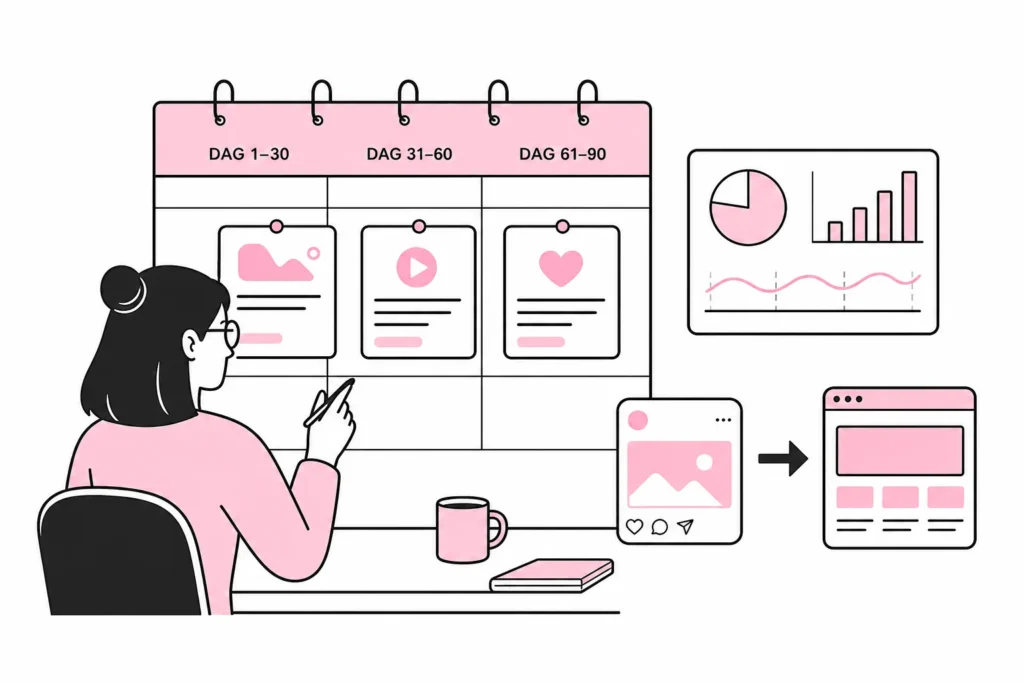
A channel selection does not have to be permanent. Run a limited trial period with clear responsibility, planned content and a few key metrics. Three months is often long enough to test the workflow and see signs of whether the content is reaching the right audience, without pretending that a short campaign provides the answer for all time.
- Choose one primary goal. For example, qualified visits to expert content, sign-ups or relevant enquiries.
- Set a realistic frequency. Base it on production capacity and quality, not on what some random expert claims the algorithm requires this week.
- Plan three to four content formats. These could include short professional tips, customer cases, demonstrations and answers to frequently asked questions.
- Tag traffic consistently. Make sure visits from different posts and campaigns can be distinguished in your analytics tool.
- Track time spent. A channel that generates results but requires disproportionate amounts of production and follow-up may be difficult to sustain.
- Evaluate quality, not just volume. Look at whom you reach, what they do next, and whether the enquiries are actually relevant.
After the test period, you can increase your efforts, adjust the formats or end the experiment. The last option is not a failure. A controlled shutdown is better than a profile whose last post wished followers a happy summer three years ago. An account like that is roughly equivalent to an unmanned reception desk with the lights on.
Also remember the practical aspects of ownership. Use company-managed accounts, document who has administrator rights, and remove access when roles change. Do not keep the entire channel strategy in the head of one enthusiastic employee. Heads are good for many things, but they have limited support for transferring knowledge when someone changes jobs.
A good channel selection should withstand a simple explanation
You should be able to explain each channel in one sentence: We use this channel to reach this target group with this content, so that they can take this next step. If the sentence is full of buzzwords, the choice probably has not been fully thought through.
Social media are rented spaces. Rules, formats and visibility can change without the company having much influence. Use the channels to build relationships and awareness, but give important actions and lasting professional content a home on the company’s own website.
The right channel strategy is not the one that covers the most platforms. It is the one the organization can implement, measure and improve without the publishing plan evolving into its own municipal bureaucracy.