
An employee wants to summarise a customer case, improve a proposal or analyse a spreadsheet with artificial intelligence. The task seems harmless, and the result arrives within seconds. The challenge is that the prompt, attachment and chat history may contain personal data, trade secrets or information the company has promised to protect.
“Paste it here” has quickly become a highly popular integration architecture. It is quick to adopt, requires no development and elegantly skips over almost every question the security manager had planned to ask.
The company therefore does not need a general ban on AI. It needs clear rules for which data can be used in which tools, for which tasks and under what conditions. The rules must be short enough that employees actually use them when the working day is busy.
The short answer: Only share data in approved tools
Employees should be able to use public and harmless information in approved AI tools. Internal, confidential or personal data requires a specific assessment of both the purpose and the tool. Some types of information should not be shared at all unless the company has established a dedicated and controlled solution.
What matters is not just what the tool is called. Two services with roughly the same functionality may have different contractual terms, retention periods, access controls and settings for data use. The free and business versions of a service may also differ significantly. Therefore, “approved AI” should mean a specific service, account type and configuration—not just a familiar product name.
Think of a prompt as a document you hand over a counter, not as a thought you whisper to the computer. You should know who receives the document, how long it is kept, who can open it and how it is deleted. It is a less magical description of AI, but considerably more useful.
Use a traffic-light model for data
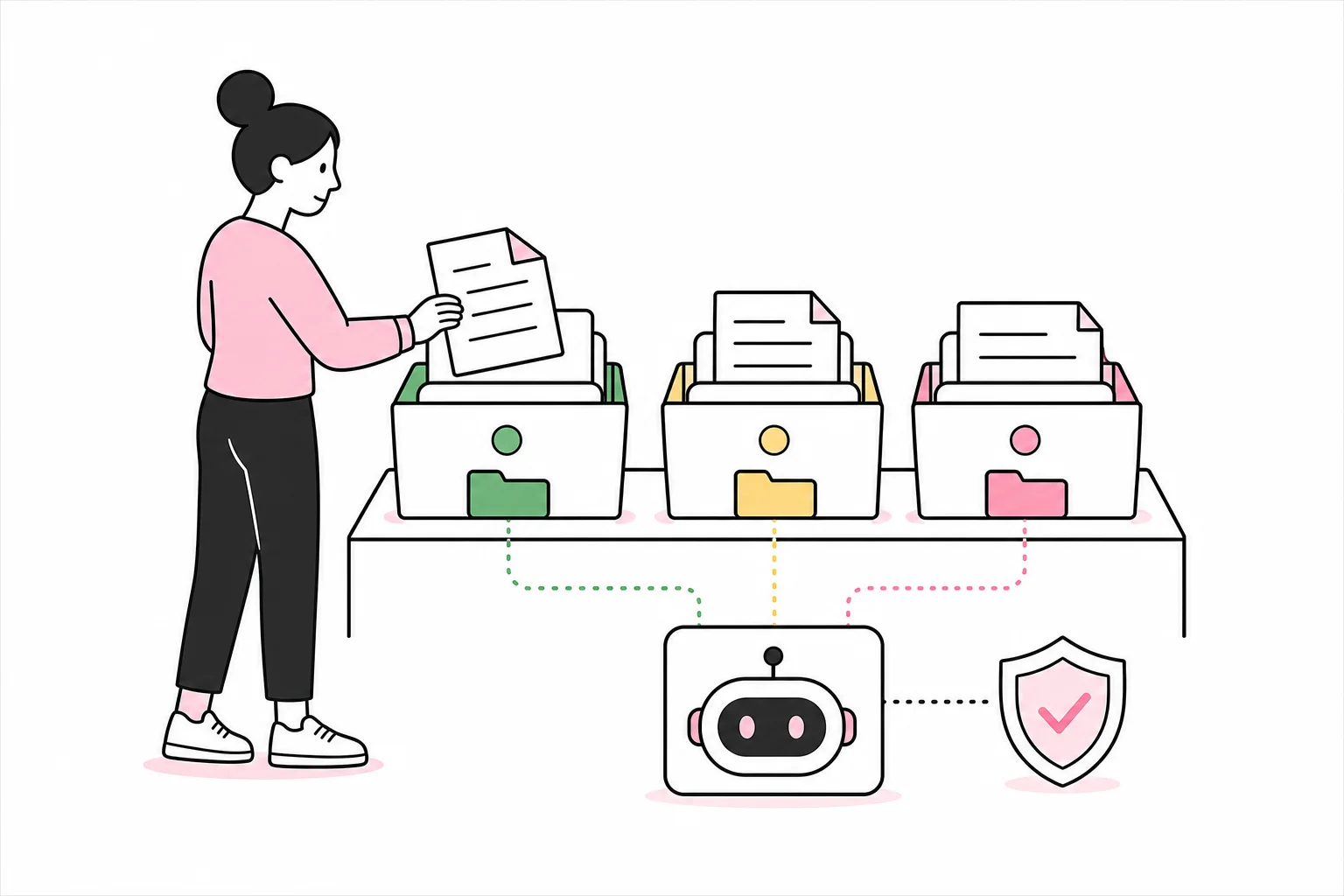
A simple classification makes it easier to make the right choices without treating every prompt as a board matter. The model should be adapted to the organisation, but three levels are often a good starting point.
Green: May be used in approved AI tools
- Text that has already been published publicly.
- General ideas and drafts without customer information or internal details.
- Fictional examples and anonymised test data.
- Proofreading of content that is not confidential.
- Summarising publicly available professional material.
Even green information should be used for a clear purpose. There is little benefit in uploading the entire document archive when the task is to write three alternative headlines. Data minimisation is a sound principle even when the content is not particularly sensitive.
Yellow: Requires an approved solution and specific security measures
- Internal procedures, strategies and financial assessments.
- Customer information that can be linked to individuals or organisations.
- Contracts, proposals and unpublished product plans.
- Source code, technical documentation and system logs.
- Personal data that is necessary for an approved work process.
For yellow data, the company should assess contractual terms, data processing, access control, storage, deletion and any transfer between countries. Where personal data is processed, the organisation must also have a legal basis for processing, provide the necessary information to data subjects and have relevant agreements in place. The need for a more extensive privacy assessment depends on the task, the types of data and the risk.
Red: Should normally not be shared
- Passwords, API keys, security codes and private keys.
- Special categories of personal data without an expressly approved solution and purpose.
- Information about personnel matters, whistleblowing cases or security incidents.
- Trade secrets that are not necessary for the task.
- Data the organisation has no right to disclose or process in this way.
Red does not necessarily mean that AI can never be used. It means that a standard web-based chat service is not the right place. Such needs may require a restricted solution, strict access control, dedicated agreements and technical processing where the data is not used for other purposes.
Keep the model short and include examples from your own organisation. An AI policy that is 19 pages long is highly effective if the goal is for everyone to improvise after page one.
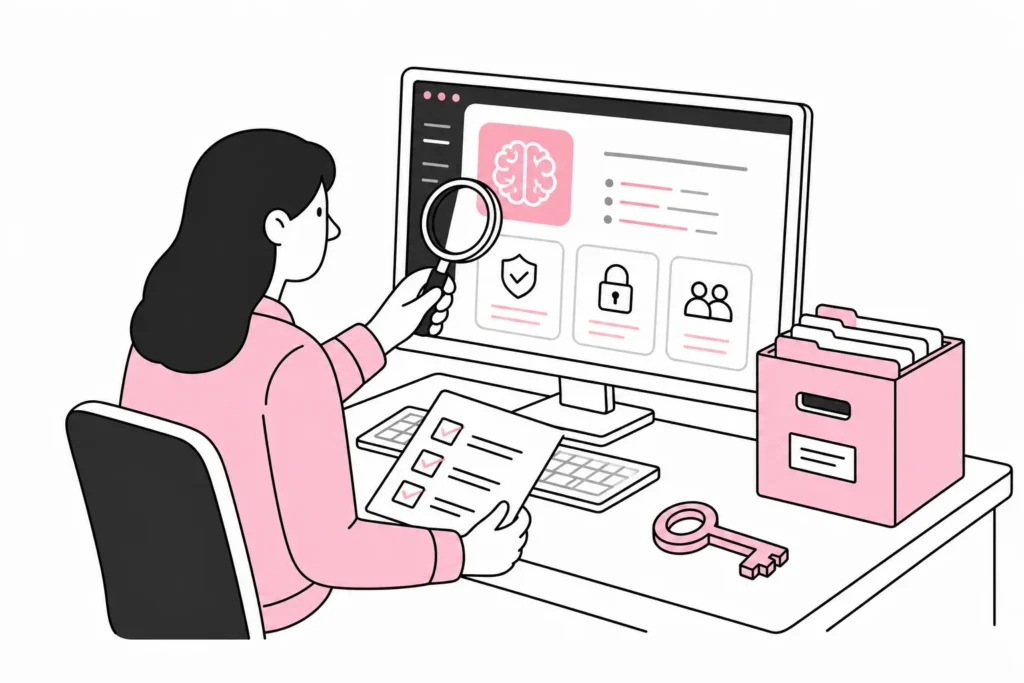
Check the tool before approving it
A vendor assessment does not need to begin as a six-month project, but it must go beyond the product page. A shield icon next to the word “enterprise” is not a data processing agreement, even if the presentation does its best to imply otherwise.
Ask for clear answers to these questions:
- Is the content used for training or product improvement? Check both the default settings and what the agreement actually gives the vendor the right to do.
- Where is the data stored and processed? Also map any subprocessors and possible transfers to other countries.
- How long are prompts, files and responses retained? Find out whether storage can be restricted and how deletion is carried out.
- Who has access? Business accounts should have central user administration, appropriate roles and the ability to quickly disable access.
- Are activity logs available? The organization should be able to investigate use and incidents without introducing unnecessary employee monitoring.
- Can data be exported or deleted? This is important when changing providers, closing accounts, and handling access or deletion requests.
- What guarantees are provided for the results? AI-generated content may be incorrect, incomplete, or based on false assumptions. Human review must be part of the workflow.
Terms and features change. Therefore, record the date of the assessment, which account type it applies to, and who is responsible for follow-up. Current claims about storage, training, and security features should always be checked against the applicable agreement and configuration.
Make the rules easy to follow in practice
A good policy does not merely state what is prohibited. It shows employees how to complete the task more safely. If a customer case cannot be pasted in directly, the employee may be able to remove names, contact details, customer numbers, and other identifying characteristics. If an entire spreadsheet is unnecessary, only relevant, aggregated values may be used.

Anonymization must be genuine. Replacing the customer’s name with “Customer A” is of little help if the prompt still contains an address, job title, case number, and a highly recognizable incident. Pseudonymized data is normally still personal data when the link can be restored.
Give employees one approved starting point with sign-in through the company account, ready-made guidelines, and a few examples. Do not spread usage across ten random services. An extra “AI security plugin” with one-click automatic compliance rarely solves this; it usually just moves the uncertainty to a more expensive menu.
The minimum rules can be brief:
- Use only tools and account types approved by the company.
- Share the minimum amount of information needed to complete the task.
- Do not enter secrets, access credentials, or red-classified information.
- Check facts, calculations, quotations, and professional conclusions before use.
- Do not publish or send AI-generated content without responsible human review.
- Report promptly if data has been shared incorrectly, so that access, storage, and further measures can be assessed.
Also appoint an owner for AI use. They do not need to approve every formulation, but should maintain the list of tools, coordinate assessments, and answer questions. Without an owner, you quickly end up with a steering group, three spreadsheets, and no one who can answer whether the customer list may be uploaded. The process has then achieved impressive maturity on paper.
Consider starting with two or three approved tasks, such as developing ideas with public data, proofreading non-confidential text, and summarizing internal documents in a controlled solution. Follow up on the questions employees actually encounter and adjust the examples. The goal is not to have as many rules as possible, but to make the correct handling the easiest way of working.
The practical answer is therefore: Employees may share data with AI when the information is classified, the tool has been assessed, and the purpose is clear. Everything else should wait until someone has done their homework. AI works quickly; there is no reason why decisions must also be rushed.