
The company may have created accounts on five social platforms because the target audience was «surely going to be there». Three years later, posts are published sporadically, the inbox is checked when someone remembers the password, and the latest post wished followers a happy summer in November. Such an account functions like a digital reception desk with the light on and no one behind it.
The question is therefore not only which channels the business should establish a presence on. You should also ask: When is it right to pause or close a social media account? The answer depends on the channel’s purpose, target audience, resource requirements and risk – not just the number of followers.
An account should have a defined job
Each account should support at least one specific business objective. It may build awareness, recruit employees, create dialogue with customers, drive relevant traffic or provide customer service. It is also legitimate to keep an account to protect the brand name, even if it is rarely used. But that should be a conscious choice, not the result of organisational forgetfulness.
Start by stating the channel’s purpose in one sentence. For example: «This account should showcase our professional environment to potential job applicants» or «The channel should make it easier for existing customers to ask questions». If the purpose is «we should be visible», it is too vague to guide content, priorities or measurement.
The term omnichannel is sometimes interpreted to mean that a business must collect platforms the way others collect refrigerator magnets. That is a misunderstanding. A coherent customer journey requires relevant channels to work together, not the marketing department to maintain every app with a login button.
Five signs that the channel should be reassessed
1. The target audience does not use the channel for what you offer
A platform can have many users without being right for the business. Look for signs that the relevant target audience actually discovers, considers or contacts the business there. Followers alone say little if they do not correspond to the customers, job applicants or professional communities you want to reach.
2. The channel lacks a clear purpose
If the same posts are copied to every account without regard to format and context of use, you probably do not have a channel strategy. You have a distribution button. Publishing tools can make copying faster, but not necessarily better. Forcing the same post into every channel is a bit like using the same key for the office, the delivery van and the coffee machine: efficient right up until you try.
3. You do not have the capacity to publish and follow up
The resource requirement involves more than creating posts. Someone must approve content, respond to comments and messages, handle notifications and follow up on any enquiries. If no one has clear responsibility, the account can create expectations the business does not meet.
Assess the actual time spent each month, including coordination and reporting. A post that takes 20 minutes to publish may first have gone through a small Nordic championship in internal approval. Cumbersome processes do not automatically mean the channel should be closed, but the cost must be included in the assessment.
4. The results do not justify the effort
Look at developments over a period that covers a representative sales cycle or season. Relevant signals may include qualified enquiries, traffic with the desired behaviour, applications, event participation, customer dialogue and contributions to campaigns. Assess both direct results and the channel’s role earlier in the customer journey.
Low organic reach alone is not grounds for discontinuation. It may be due to weak content, the wrong format, inconsistent publishing or the channel primarily functioning alongside paid distribution. Before reaching a conclusion, you should therefore test whether clearer content and prioritisation produce results.
5. The risk is greater than the benefit
A poorly monitored account may receive customer enquiries, fraud attempts or comments that go unanswered. Old accounts may also be linked to former employees, outdated email addresses, publishing tools and advertising accounts. This makes access management and incident handling more difficult.
This does not mean that every quiet account is dangerous. But the business should know who has administrator access, how the login is secured, which systems the account is connected to and who receives notifications. A channel without an owner is effectively a technical attic: No one uses it, but there is surprisingly much combustible material up there.
Use a simple assessment model
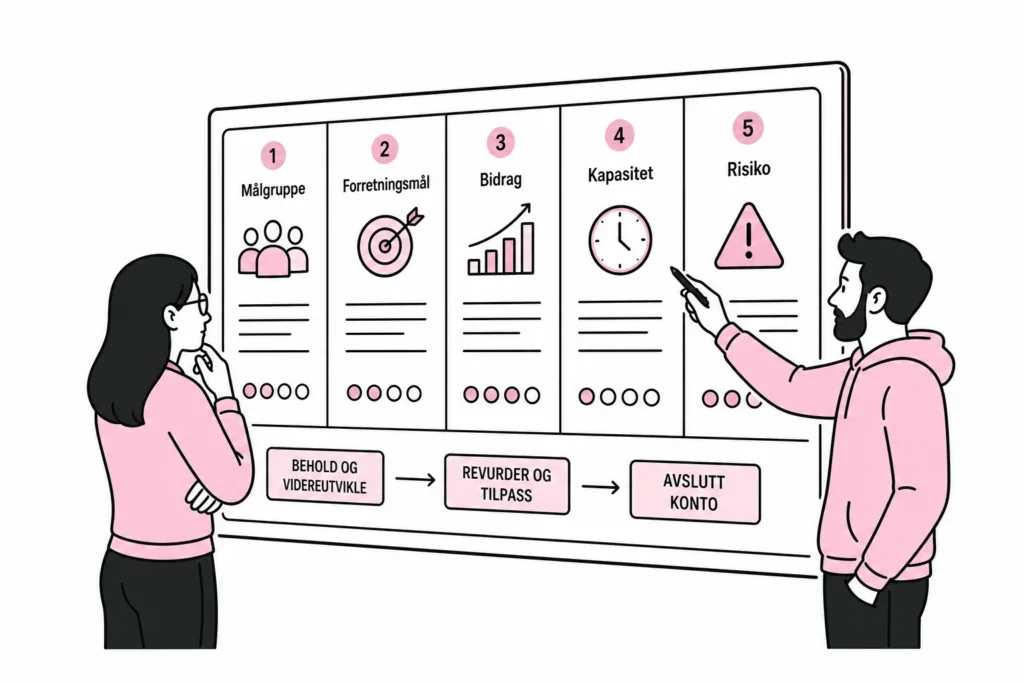
To avoid letting the decision be driven by personal favourites, you can give each channel a score from zero to two in five areas:
- Target audience: Are the right people active and receptive on the channel?
- Business objective: Does the account have a clear purpose linked to the business’s priorities?
- Contribution: Does the channel generate relevant results or useful dialogue?
- Capacity: Do you have the time, expertise and responsibility to run it properly?
- Risk: Are access, moderation and integrations under control?
The score is a decision-making tool, not a law of nature. An account with a low contribution but high value as name protection may still be retained. A channel with good results but inadequate access management should be secured rather than discontinued. The model is meant to bring out the trade-offs, not produce a magical green light on a dashboard. The online industry already has enough traffic lights pretending to drive strategy.
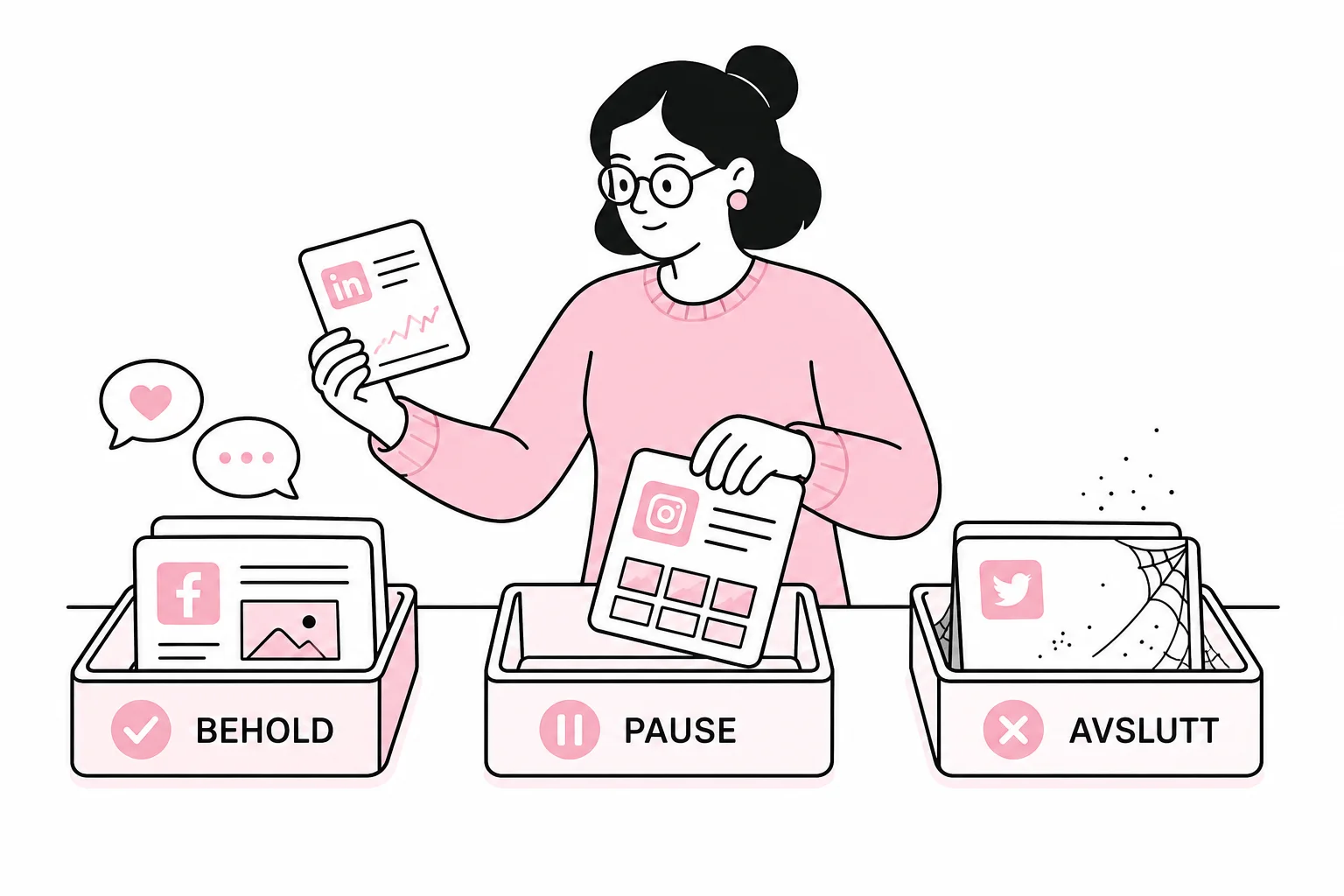
Then choose one of three outcomes: continue, pause and test or discontinue. When pausing, define what should change, who is responsible, how long the test will last and which signs will determine the next step. Without such criteria, a «temporary pause» often becomes merely a polite term for permanent neglect.
How to close the account properly
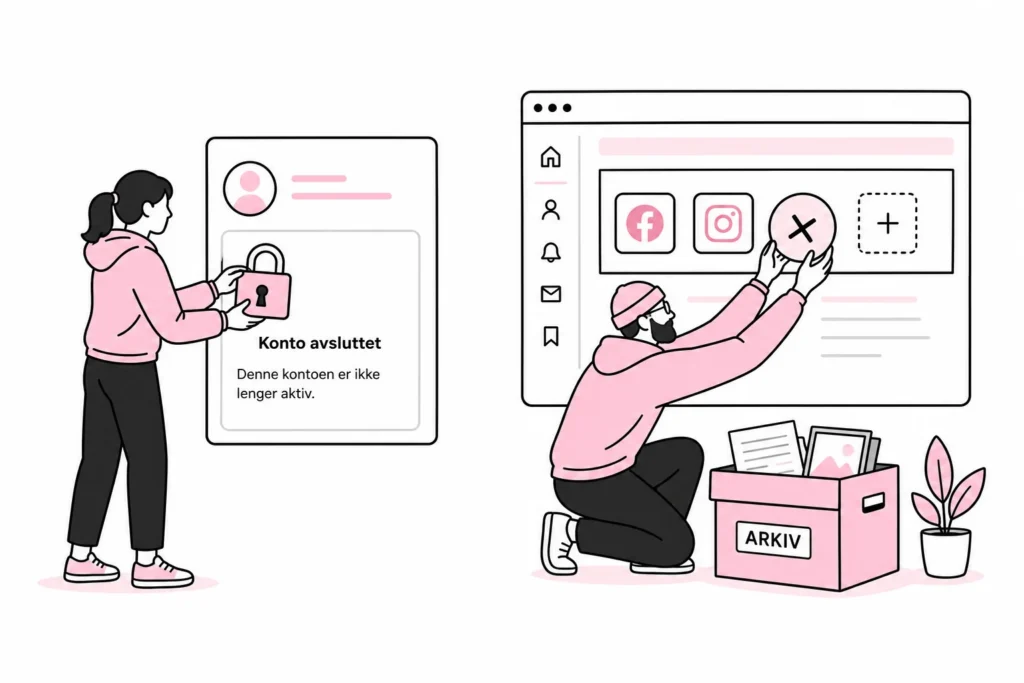
Do not start by clicking delete. Platforms’ settings and rules can change, so always check which options apply before choosing between deactivation, deletion and an inactive profile. Also assess the risk that someone else could take over a released username or impersonate the business.
- Map ownership and access. Find administrators, login methods, associated email addresses and any external partners.
- Close open enquiries. Follow up on relevant messages and customer cases before the account is closed or stops being monitored.
- Retain necessary material. Archive content, reports and decision-making documentation in line with the organisation’s own procedures and applicable requirements.
- Inform followers as needed. If the account has an active audience, briefly explain that it is being closed and state which channel the company will use going forward.
- Update contact points. Remove or replace the channel icon on the website, in email signatures, presentations, campaign materials and internal templates.
- Stop integrations and costs. End scheduled publishing and campaigns, revoke unnecessary system access and check the payment setup.
- Document the decision. Note why the account was closed, who approved it and where any archived material can be found.
The process needs one person responsible and a short checklist. It rarely needs a steering group, three workshops and a new framework called “Social Exit Journey”. Turning off a channel in a controlled manner is still just good maintenance, even if that sounds less billable.
After closure, monitor whether customers continue to mention or try to contact the company through the channel. This may reveal that profile information, search results or old materials are still directing people the wrong way. Carry out another review after an agreed period and update the channel overview.
The goal is not to be present in as few places as possible. It is to be properly present where it makes sense. Two active, relevant and well-managed accounts are usually more valuable than six profiles that mainly document that the company once had a strategy workshop.