
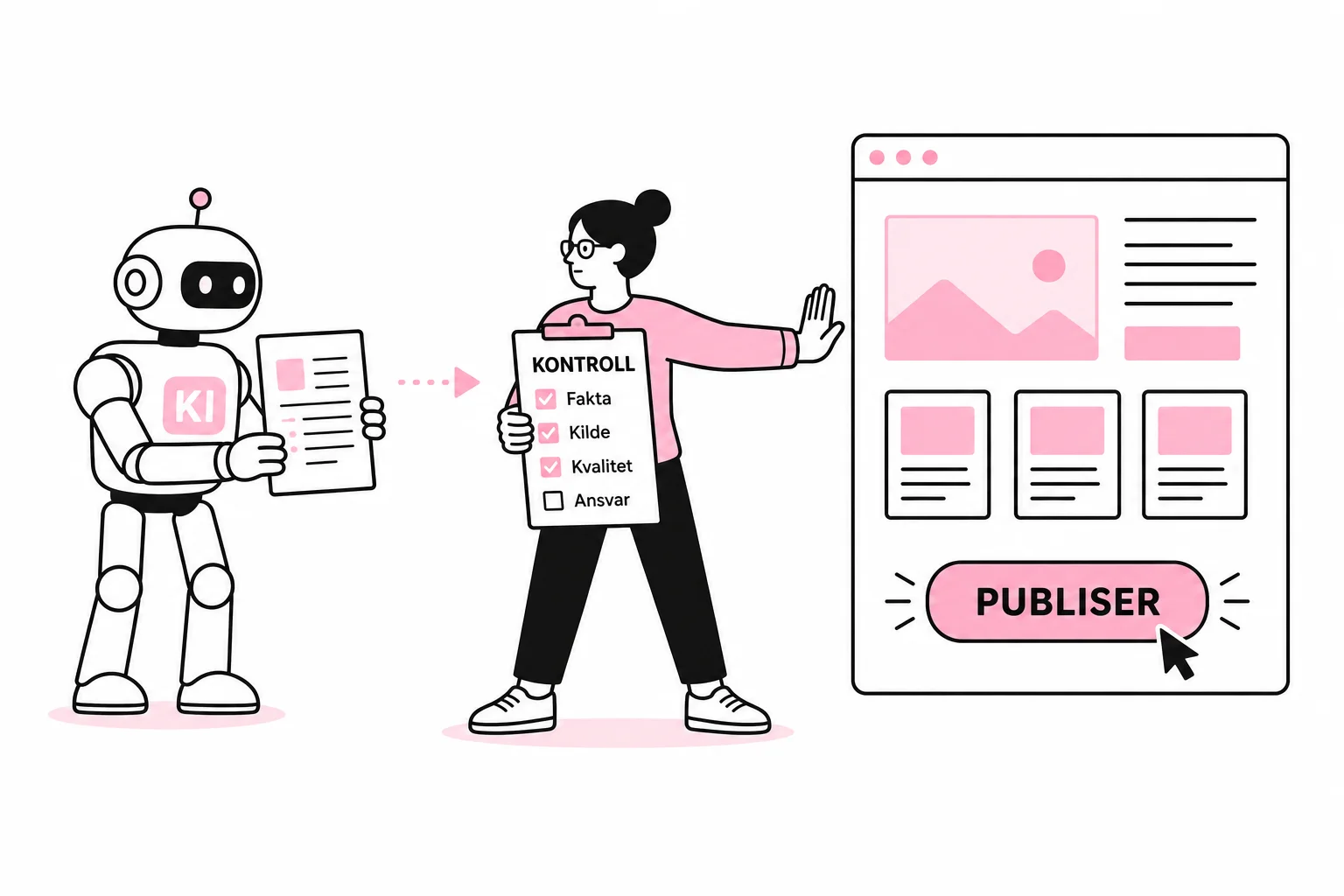
AI tools can write product copy, expert articles, help text and meta descriptions faster than most editorial teams. The specific question is therefore not whether AI can produce the text, but whether it can be published directly on the website without human review.
The short answer is usually no. A well-written text can still contain errors, vague promises or information that does not apply to your business. Linguistic confidence is not the same as subject-matter accuracy. Sometimes AI-generated text is just guesswork in a suit.
That does not mean everything has to be treated like an op-ed from the CEO. The goal is to tailor the review to the level of risk. A meta description for an old article requires a different review than text about prices, security, health or terms and conditions.
Assess the consequences before assessing the text
Start by asking what could happen if the content is wrong. This provides a more useful assessment than discussing whether the text “sounds human”. An incorrect opening time is concrete and irritating. An inaccurate description of a warranty, treatment, price or data security can have far greater consequences.
Consider dividing AI-generated content into three risk levels:
- Low risk: headline suggestions, meta descriptions, internal summaries and language variations of content that has already been reviewed.
- Medium risk: blog posts, landing pages, product descriptions and help text that affect the customer’s understanding or purchasing decision.
- High risk: prices, terms and conditions, legal wording, safety advice, health information, financial advice and specific claims about products or competitors.
Low-risk content can often be handled with a quick editorial review. Medium-risk content should be reviewed by someone who knows both the subject area and the target audience. High-risk content requires a named subject-matter owner and explicit approval. If no one in the organisation can verify that the text is accurate, you have no basis for publishing it either.
This classification also prevents every text from being sent through an approval process involving six people, three spreadsheets and a meeting about the meeting structure. Review should reduce risk, not create a smaller local government.
Check facts, promises and omissions
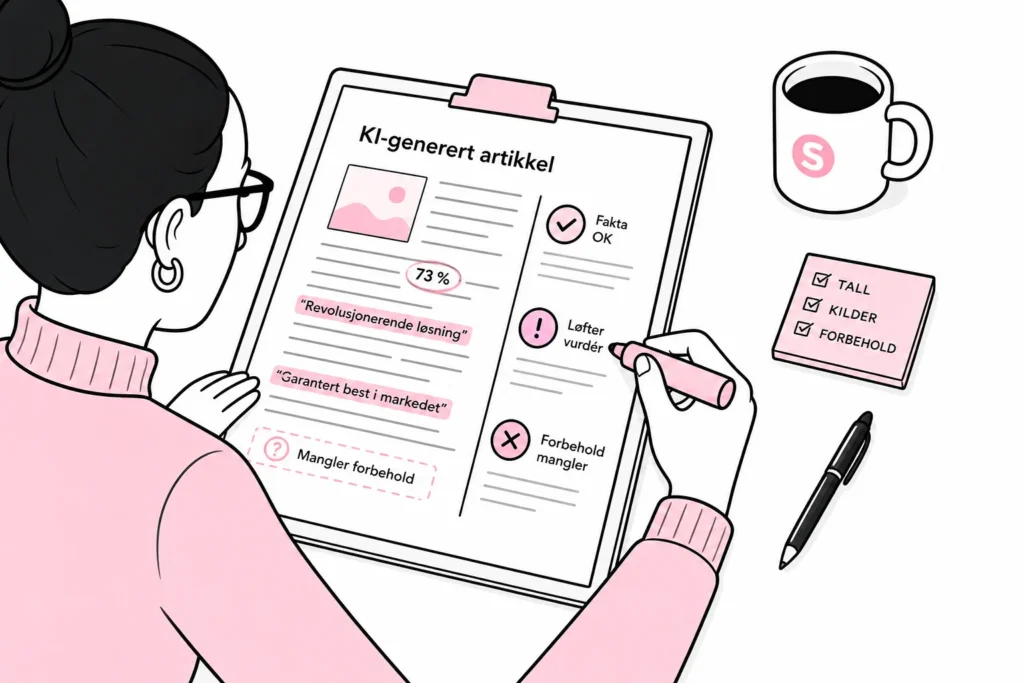
A good copy-edit is not enough. The most important review concerns what the text actually claims. AI can combine general knowledge, information from the instructions and plausible wording into an answer that sounds precise. The result may be correct, partially correct or elegantly wrong.
1. Flag all verifiable claims
Review figures, dates, product features, prices, opening hours, warranties, certifications and descriptions of laws or regulations. Every claim should be verifiable against up-to-date, authoritative material. The fact that the same information appears twice in the AI draft does not count as double evidence.
2. Look for promises the business has not approved
AI readily produces phrases such as “always available”, “complete security”, “guaranteed results” or “suitable for everyone”. Such expressions may be stronger than the business can actually stand behind. Replace them with precise descriptions of what the customer receives, what limitations apply and who the offer is suitable for.
3. Check what the text does not say
A text can be factually correct and still be misleading because important caveats are missing. If a service requires an upfront fee, a commitment period, technical expertise or specific integrations, this should be made clear. AI is often good at filling a page and less concerned with the small detail that generates fifteen support tickets.
4. Compare it with the business’s actual offering
Generic wording can make the business look like everyone else in the market. Check that the text uses the correct product names, ways of working, geographical areas and contact points. A “magical brand module” that promises to give every draft the right tone is mostly autocomplete wearing a tie. It may help, but that does not mean it knows your decisions.
Create a workflow that provides genuine human oversight
The term “human in the loop” is often used as a guarantee of safe AI use. In practice, it can mean that one person receives 73 texts for approval at 3:58 p.m. on Friday. Genuine oversight requires time, accountability and the ability to stop publication.
A simple workflow could look like this:
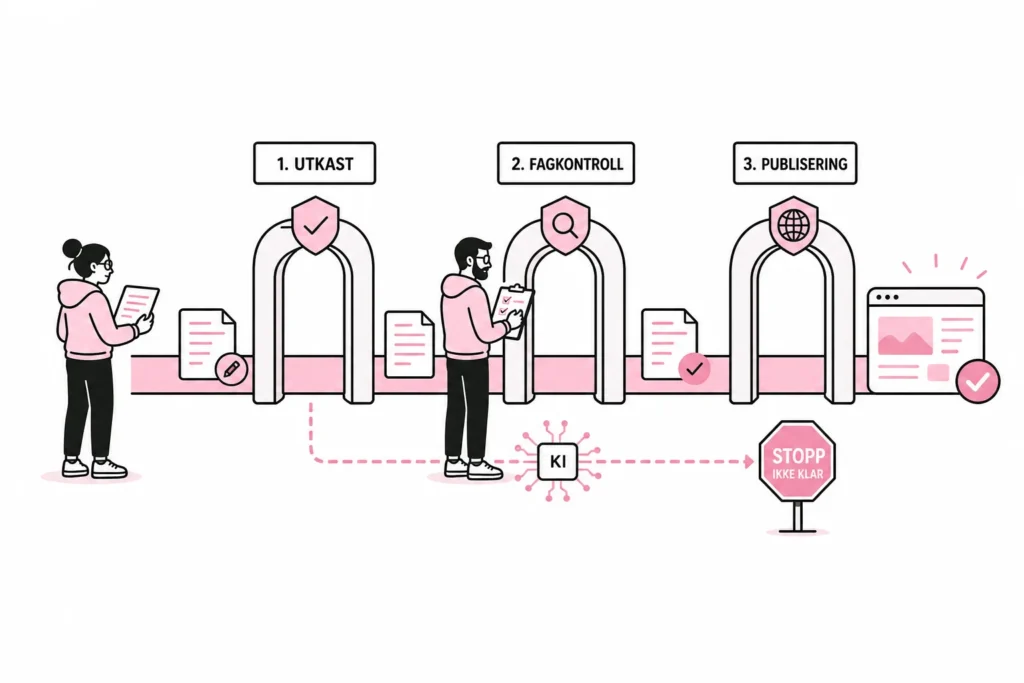
- Commission the draft: Give the AI tool a clear purpose, target audience, format and approved factual basis.
- Record the origin: Record that the text was AI-assisted, what source material was used and who commissioned it.
- Perform a subject-matter review: Someone with relevant expertise checks the claims, omissions and caveats.
- Perform an editorial review: An editor assesses the language, structure, tone, accessibility and whether the text actually meets the user’s needs.
- Approve according to risk: Medium- or high-risk content must have a named approver before publication.
- Set a date for the next review: Time-sensitive content should be given a review or unpublishing date.
It is useful to distinguish between the person who creates the draft, the person who reviews the subject matter and the person responsible for publication. In small businesses, the same person may fill several roles, but the roles should still be clearly defined. That way, you know who should act when a price changes or a product feature disappears.
Also ask for visible changes between the AI draft and the approved version. If the editor repeatedly has to fix the same problems, the instructions, factual basis or area of use should be improved. AI should reduce routine work, not create a proofreading subscription service.
When can parts of publication be automated?
Automation can be appropriate when the content has limited consequences, is based on structured and controlled data, and can be stopped quickly. One example is generating drafts of meta descriptions for existing pages. The system can fill a queue while an editor approves the texts as a batch before they are published.
That is different from allowing an AI model to create and publish complete pages on its own. Direct publication connects an uncertain text generator to the business’s public channel. It is like giving a very fast intern the master key and removing the door lock to streamline onboarding.
If you automate, the solution should have clear boundaries:
- AI should only be able to work with agreed content types and data fields.
- Changes should be logged with a timestamp, content and responsible process.
- There should be a preview, approval and easy rollback.
- The system should stop if required data is missing or the format deviates.
- Published pages should be monitored for broken templates, empty fields and unexpected changes in volume.
Be especially skeptical of solutions that promise fully automated content production, publishing, search engine optimization and branding at the click of a button. When four disciplines are reduced to a switch, it is often the control that has been removed—not the work.
Use a fixed checklist before publishing
A short checklist provides more consistent quality than a general instruction to “review the text.” It should be available in the publishing tool or workflow, not hidden in a strategy document no one has opened since the kickoff.
- Have all facts, figures and specific claims been checked?
- Does the text align with current prices, products, terms and procedures?
- Are any important limitations or caveats missing?
- Is the language understandable to the target audience without unnecessary jargon?
- Does the text have a clear purpose and a relevant next action?
- Is the content materially different from existing pages?
- Have personal data, confidential information and internal instructions been removed?
- Have the responsible approver and the date of the next review been recorded?
AI-generated content should therefore not get a free pass onto the website just because it is grammatically polished. Use the technology for ideation, first drafts, rewriting and structuring, but let the level of control reflect the consequences of errors. The best workflow is not the one with the most approval boxes. It is the one that makes it easy to publish the right content and difficult to publish content you cannot stand behind.