
Many companies start their AI work by asking which tool they should buy. That is usually the wrong place to start. The useful question is: Which specific work task can we improve without making mistakes more costly, accountability unclear or the process more complicated?
The best first task is rarely the one that looks most impressive in a presentation. It is often repetitive, limited and slightly boring. Sorting enquiries attracts less attention than an “autonomous AI agent”, but the former has the advantage that someone actually knows what it is supposed to do. A 48-slide AI strategy can also be automated, but for now the benefit is mainly aesthetic.
The goal of the first project should be to learn how AI works in a real work process: where it saves time, what mistakes it makes, what employees need to check, and whether the cost is proportionate to the benefit. You do not need to start with a business-critical revolution. A controlled improvement is more than enough.
Start with the task, not the technology
First, make a list of tasks that employees spend a noticeable amount of time on. Look for work that involves reading, summarising, categorising, comparing or creating a first draft. These are tasks where generative AI can often contribute, because the result is based on interpreting text or other unstructured content.
A good candidate usually has several of these characteristics:
- The task is repeated frequently and performed more or less the same way each time.
- The input and expected result can be clearly described.
- An employee can check the result in less time than it would take to create it from scratch.
- Errors can be detected before they affect customers, finances or rights.
- You have enough representative examples to test the solution.
- Time spent, quality or turnaround time can be measured before and after.
Suitable initial tasks might include categorising incoming forms, summarising internal meeting notes, suggesting metadata for documents or creating first drafts of replies based on approved information. The point is not for AI to take over the entire process. It should make a clearly defined part of it faster or easier.
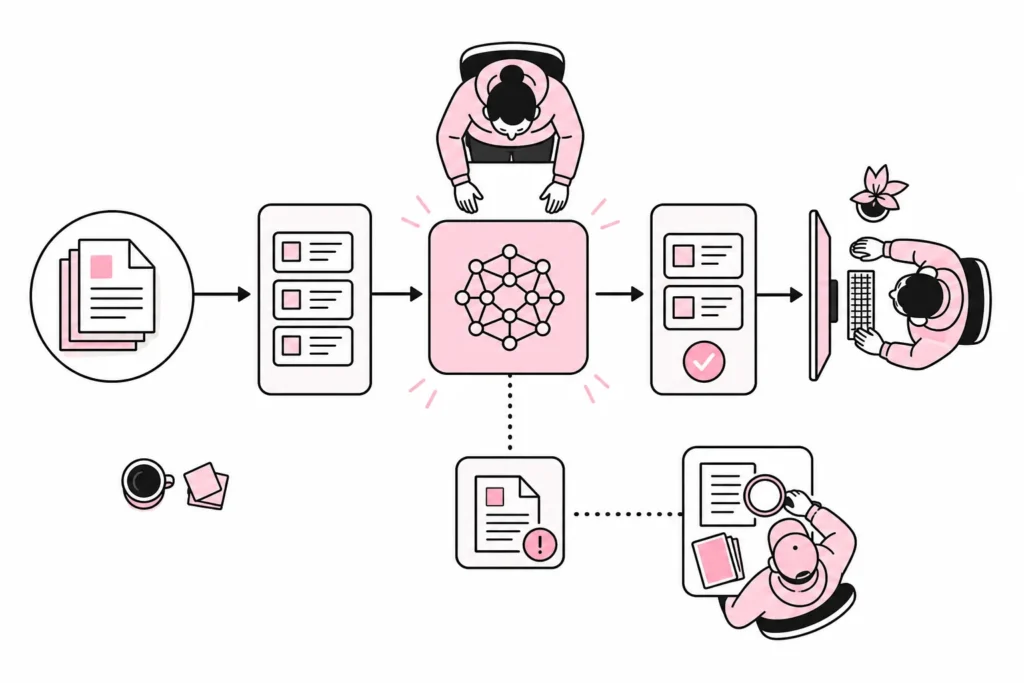
Avoid choosing a process simply because it is visible to management. High visibility often means serious consequences if something goes wrong. It is roughly like learning to drive by starting with deliveries in a pedestrian zone: possible, but unnecessarily challenging from a learning perspective.
Clarify whether you actually need AI
Not every manual task is an AI task. If the work can be described using fixed rules, conventional automation is often less expensive, more predictable and easier to control. A system does not need to “understand” an invoice to move it to the right folder if the supplier number already determines where it belongs.
Use conventional automation when
- the decision follows unambiguous rules
- the input has a fixed and known format
- the same input should always produce the same result
- it is important to be able to explain every step precisely
- the margin for error must be extremely low
Consider AI when
- the input consists of free text, images or varying documents
- the task requires categorisation, summarisation or linguistic assessment
- there are several acceptable answers
- a person can review the result before it is used
- the value lies in a good suggestion, not a guaranteed answer
Using an advanced AI agent to rename files can be like hiring an orchestra to play the doorbell. It certainly works, but fixed rules or a small script will often do the job more cheaply and with fewer surprises.
Also consider whether the process itself is mature enough to automate. If three departments perform the task in four different ways and no one owns the result, AI will only produce ambiguity faster. Automating an unstable process is a bit like fitting cruise control to a shopping trolley: more technology, but still poor directional control.
Give the candidates a simple score
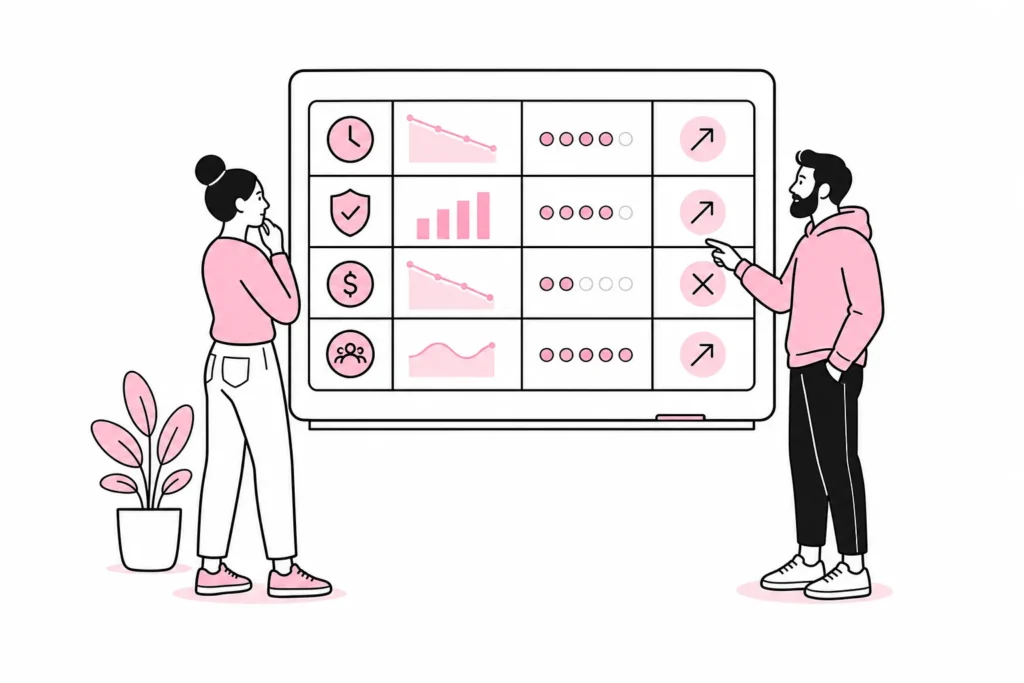
Once you have identified several possible tasks, they should be assessed using the same criteria. A scale from one to five works well. The scoring model does not need to be scientific; it should make the prioritisation visible and prevent the project from being chosen based on who used the most buzzwords in the meeting.
- Business value: How much time, waiting or manual work can the task reduce?
- Data access: Do you have lawful access to sufficient and representative material for testing?
- Controllability: Can a subject-matter expert quickly determine whether the result is good enough?
- Consequence of errors: What happens if the model misunderstands, omits information or makes something up?
- Technical effort: Does the pilot require major integrations, or can it be tested on a limited basis?
Prioritize tasks with high utility, easy oversight and low consequences if things go wrong. A high-volume task may seem tempting, but high frequency also amplifies poor results. If five per cent of responses require extensive cleanup, you should know how many cases that actually represents.
Also involve the employees who perform the task. They know the exceptions, shortcuts and quality requirements that rarely appear in the process description. A workflow designed without them quickly becomes more polished than reality, which is unfortunately a well-established genre in digitalization projects.
Build a pilot with clear quality gates
A pilot should be tested on historical or controlled cases before the solution is allowed to influence real decisions. First define what counts as a correct, usable and unusable result. Without such criteria, the evaluation often ends with someone saying “it seems quite smart,” which is a weak basis for both budgeting and operations.
- Measure the current process. Record time spent, errors, waiting time and how much follow-up work the task requires.
- Choose a representative test set. Include routine cases, demanding cases and known exceptions.
- Define the model’s role. Should it suggest, sort, summarize or decide? In an initial pilot, it should normally make suggestions.
- Build in human oversight. Decide who approves the result and what the oversight should cover.
- Log deviations. Distinguish between minor language errors, missing information, incorrect categorization and fabricated content.
- Compare with the baseline. Measure total time spent, including checking and corrections.
Human oversight must be an actual work task, not a sentence in the project plan. If the employee has to read all the source material, check every detail and rewrite half the result, you may have moved the work rather than reduced it.
At the same time, limit which data the pilot uses. Clarify access controls, storage, deletion, supplier terms and whether the information may contain personal data, trade secrets or other protected material. The requirements depend on the data, the intended use and the applicable regulations. Solutions that affect people, rights or material decisions require a more thorough legal and professional assessment than an internal summarization function.
Keep the technical architecture modest as well. Five AI add-ons, three integration tools and a “magical” workflow can turn a small pilot into technical lasagna. Start with as few components as possible, document the flow of information and ensure that the solution can be switched off without dismantling the rest of the business.
Measure whether the solution deserves to stay
After the pilot, you should be able to answer whether the solution produces better results than the current way of working. Do not measure only how quickly the model produces an answer. What matters is the overall impact after checking, corrections, training and technical operations.
- How much time is saved per case and in total?
- What proportion of the suggestions can be used without significant changes?
- What errors occur, and how serious are they?
- Does the quality become more consistent or more variable?
- Do employees find the process easier?
- What do the tools, integration, follow-up and oversight cost?
- Can the solution be monitored and maintained by someone with clear responsibility?
Set thresholds in advance for when the pilot should be scaled, adjusted or stopped. The last option is important. Some pilots become permanent because no one agreed where the off switch was—a governance model with a certain historical prevalence.
The right first AI task is therefore not the most ambitious one. It is the task where you can describe the problem, measure the baseline, check the result and handle errors before they have consequences. If you succeed, the company gains more than a demonstration: You gain a method for assessing where AI actually creates value, and where a good old-fashioned rules-based system still does the job without requiring its own innovation program.