


A customer asks a specific question under a post. The person responsible for marketing assumes customer service will reply. Customer service thinks the question belongs to sales, while sales has not seen the comment. Three days later comes the follow-up: “Is anyone monitoring this?” Unfortunately, comments have little respect for the organizational chart.
Companies that use social media therefore need more than a publishing plan. They need a simple plan for who reads, who responds and which matters should be passed on. The goal is not to answer everything within seconds, but to prevent important enquiries from being left unattended because responsibility is unclear.
A good plan should cover open comments, direct messages, mentions and replies to ads. Without a shared way of working, the inbox quickly becomes the digital equivalent of a kitchen drawer containing batteries, receipts and one key that nobody recognizes.
Assign roles before assigning passwords
Start by appointing someone responsible for each channel. This person does not need to write every reply, but must ensure that enquiries are noticed and followed up. The role should have a named deputy for holidays, illness and other absences. “Someone in marketing” is not a role description. It is a hope.
For each channel, you should clarify the following roles:
- Channel owner: Has overall responsibility for procedures, access and quality.
- First line: Reads comments and messages, answers common questions and routes the rest.
- Subject matter expert: Contributes when the answer requires product, service or industry knowledge.
- Escalation owner: Makes decisions in cases involving serious complaints, security incidents, threats or legal consequences.
- Deputy: Takes over when the regular person responsible is unavailable.
In smaller companies, one person may fill several roles. What matters is that the responsibilities are explicit. Write them down along with contact information and the expected response time. The plan must be accessible without anyone having to search through a project room created during a strategy session four years ago.
Sort enquiries by what they require
Not all comments should go through the same process. A question about opening hours can be answered directly. An allegation of incorrect invoicing requires investigation. A message containing personal data should be moved to a suitable, approved channel.

A simple response matrix can be divided into three levels:
1. Common enquiries
These are questions the first line can answer using up-to-date information: opening hours, delivery, availability, events and general product questions. It is useful to prepare standard response templates, but adapt them to the question. A human response should ideally give some small indication that the question was actually read.
2. Matters requiring specialist clarification
These may include technical questions, complaints, price discrepancies or criticism requiring fact-checking. The first line should confirm that the matter has been seen and explain how it will be followed up, without promising an outcome before the matter has been investigated.
Define who should be contacted for different areas of expertise and how quickly that person should respond internally. An approval process should be proportionate to the risk. If a reply about opening hours has to pass three managers and a lawyer, the semicolon has gained more control than the business.
3. Matters to be escalated immediately
Threats, suspected fraud, the publication of sensitive information, security-related messages and serious allegations should be handled according to a separate contingency procedure. Preserve the necessary documentation, limit further exposure where appropriate and involve the responsible people. Do not discuss details publicly while the facts remain unclear.
Decide what you will respond to, hide and remove
Criticism is not the same as abuse. A negative comment can be factual, relevant and useful even if it is uncomfortable. Deleting all criticism is rather like dismantling the smoke alarm because the sound feels negative. The problem rarely becomes smaller as a result.
Create clear moderation rules that distinguish disagreement from content that should not remain. It may be appropriate to hide or remove comments containing personal data, harassment, threats, attempted fraud, spam or obviously irrelevant advertising. Document serious cases before removing the content, and note why the action was taken.
In response to legitimate criticism, the reply should normally do three things:
- Show that you understand what the person is reacting to.
- Correct any factual errors without becoming defensive.
- Explain the next step, or move the conversation to a more suitable channel if the matter requires personal data.
Avoid asking the customer to post an order number, telephone number, health information or other private details in the comments. Instead, explain how the person can contact you through a channel the company has approved for that type of information.
Build a workflow that is actually used
Decide how often the channels should be checked on weekdays and whether anyone monitors them outside normal working hours. The need depends on the business, the channels and what customers use them for. A restaurant, online retailer and consultancy will naturally have different expectations and risk levels.
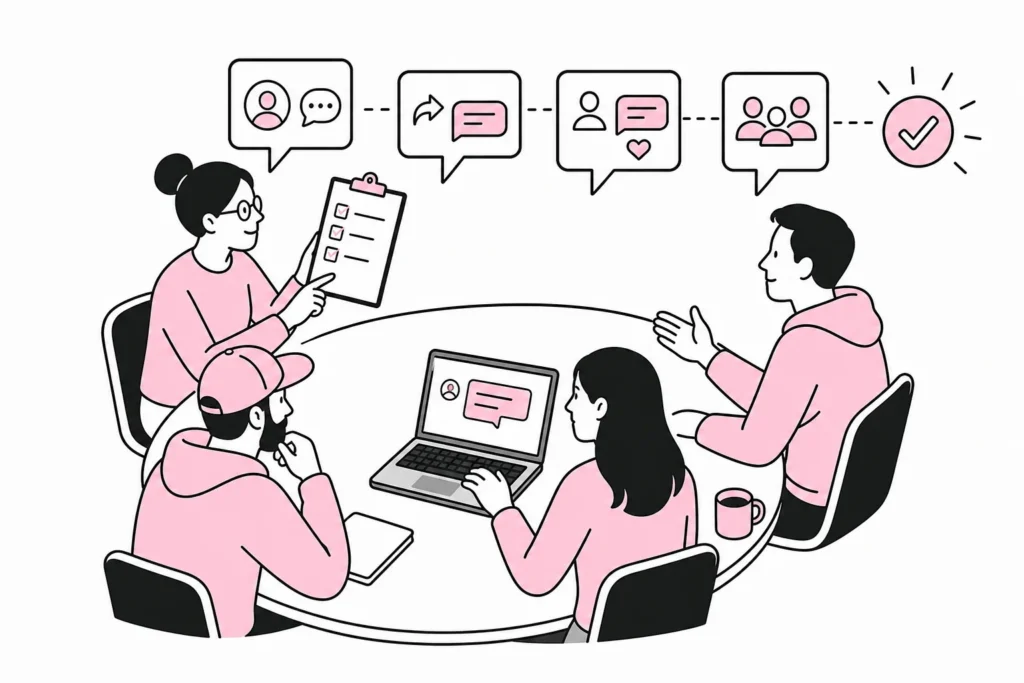
Set internal targets for first response and resolution. The first response can be a brief confirmation that the matter is being investigated. That is better than silence, but only if someone actually follows up. An automated reply is not a resolved matter; it is a receipt with ambitions.
Collect approved wording for common situations, but do not build a library of a hundred responses that nobody can find. Five to ten good starting points are often more useful than a “magic conversation tool” that classifies mood, intent and the position of the moon before sending “Thank you for your enquiry”.
If volume is low, the platforms’ own inboxes may be sufficient. With more channels, many enquiries or several employees, a shared tool can provide better distribution, status tracking and history. Choose tools based on specific needs such as access control, internal assignment, logging and reporting. A dashboard with 47 graphs is not automatically customer service, even if it looks busy.
Test the plan with realistic scenarios
A routine is only useful when employees can use it without having to interpret an extensive process map. Test the plan with a few specific scenarios: a dissatisfied customer, a comment containing personal data, a technical question, a fake profile and a serious allegation without documentation.
Check whether employees know who to contact, where to register the matter, and what they can respond to without approval. Repeat the test when you change employees, create new channels or change tools.
A practical minimum plan should include:
- A named owner and deputy for each channel.
- Fixed times for checking comments and messages.
- A response matrix covering common matters, specialist matters and escalation.
- Rules for moderation, documentation and personal data.
- Internal targets for initial response and further follow-up.
- A contact list for subject-matter leads, management and emergency response.
- A procedure for marking matters as dealt with.
The plan does not need to be long. One or two pages with clear roles and examples are often enough. What matters is that someone owns it, that employees know it, and that it is updated when reality changes. Social media move fast; internal clarifications have no comparable force of nature. That is why they must be organised.