
It takes only a few seconds to paste a customer email, an employment contract or a snippet of source code into an AI tool. The benefit may be a faster response, a better draft or an explanation of why the code refuses to cooperate. The risk is that the information is simultaneously processed somewhere the organisation has not assessed or does not control.
Empty prompt fields work much like open moving boxes: People feel a strong need to fill them, often with more than they originally intended. That is why it is not enough to tell employees to “use common sense”. They need specific rules for which information can be used, in which tools and under what conditions.
The short answer is that employees should only paste in information when the content, purpose and AI service have all been approved. A business agreement with the right settings may be suitable for tasks that should not be performed in an open consumer service. At the same time, not all data becomes harmless just because the tool has been given a company logo and simple sign-in.
Start with the information, not the AI tool
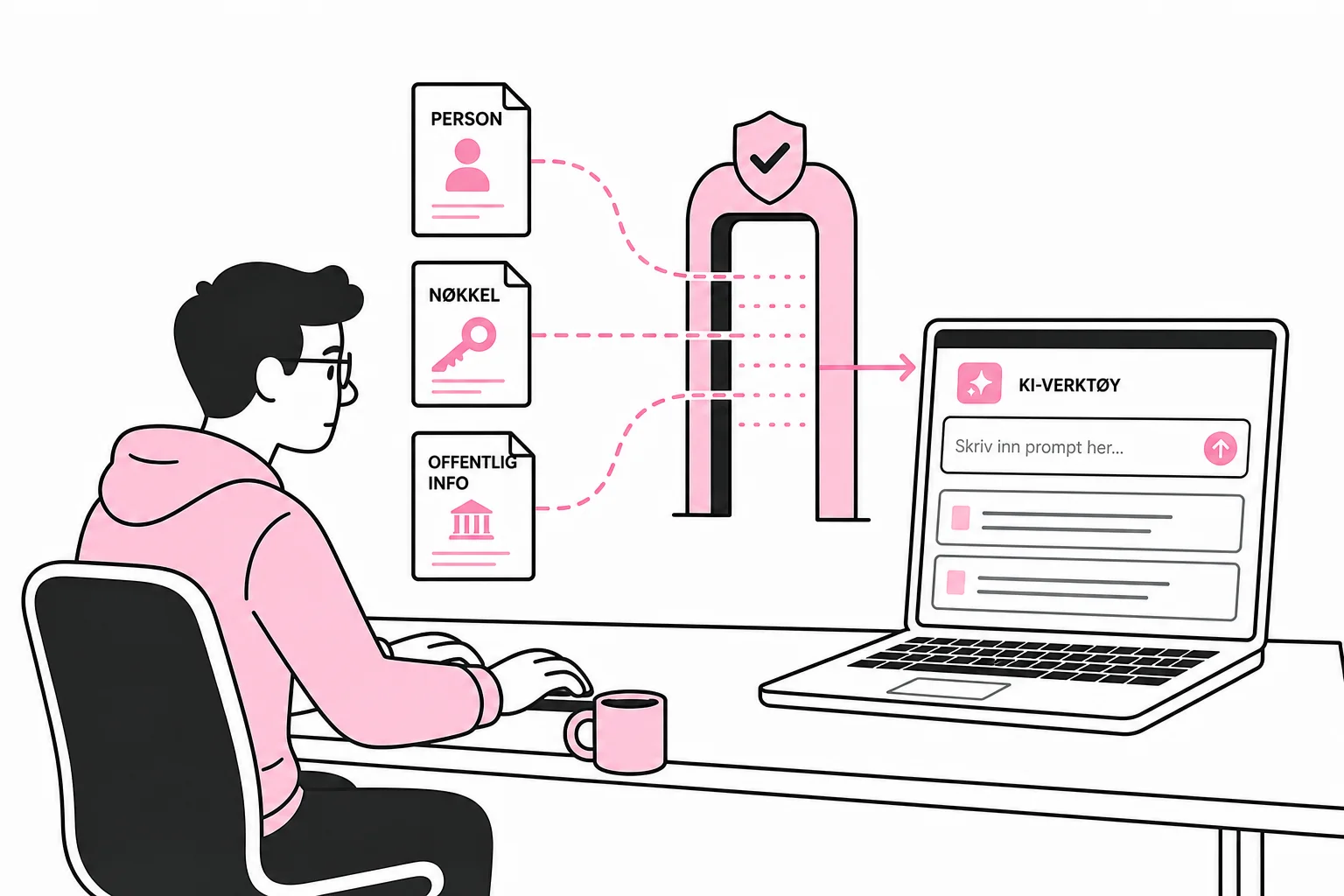
The most important consideration is not whether an AI model is impressive, but what you give it access to. Treat input as information sent to an external service. This applies to text, documents, images, spreadsheets, audio files, source code and data entered automatically through integrations.
Pasting an entire customer list to get help with a single formulation is like taking the entire filing cabinet to an unfamiliar meeting room because the whiteboard there is better. The task may be legitimate, but the amount of data is clearly greater than necessary. In practice, data minimisation means using as little information as possible and removing identifying details when they are not necessary.
The following types of information should normally not be used in an AI tool unless the service, purpose and processing have been explicitly approved:
- Personal data: Names, contact information, customer enquiries, employee data, CVs, recordings and other information that can be linked to individuals.
- Special categories of personal data: Information about, among other things, health, political opinions, religion, trade union membership or biometric characteristics.
- Confidential business information: Agreements, proposals, budgets, strategies, board documents, unpublished results and internal assessments.
- Security information: Passwords, API keys, access tokens, configuration files, vulnerability details and logs that may contain secrets.
- Protected material: Customer material, licensed content or documents the organisation has no right to use in this way.
This does not mean that AI can never be used with personal data or internal documents. It may be possible in a controlled solution with a legal basis for processing, a data processing agreement, access controls, an appropriate retention period and the necessary risk assessments. The point is that the decision must be made by the organisation, not improvised by an individual employee between two meetings.
Ask four questions before sharing information
1. Who processes the data?
Map the provider, any subcontractors and which services actually receive the information. A browser extension may send content to systems other than the AI service you think you are using. Installing three add-ons to make a single text field “smarter” is an effective way to build a small supply chain that nobody quite remembers to document.
2. What happens to the input?
Check whether conversations and files are stored, how long they are retained, whether they are used to improve models and whether administrators can control these options. Terms and features vary between subscriptions and may change. They must therefore be checked against the specific agreement and configuration you use. A shield icon in the admin panel is pleasant graphics, but it is not a data processing agreement.
3. Where is the information processed?
The organisation must know where data is processed and stored, and whether it is transferred to countries or entities requiring specific assessments. This must be considered together with the type of information, legal requirements, customer requirements and the organisation’s own agreements. Do not assume that “European sign-in” automatically means that all processing takes place in Europe.
4. Can the task be solved with less data?
Remove names, customer numbers, email addresses and other identifiers when they are not necessary. Use synthetic examples for ideation, training and testing. If you are improving a response to a customer, it is often enough to describe the problem in general terms instead of pasting in the entire email thread with signatures, order history and an attachment from 2019.
Use a simple traffic-light model
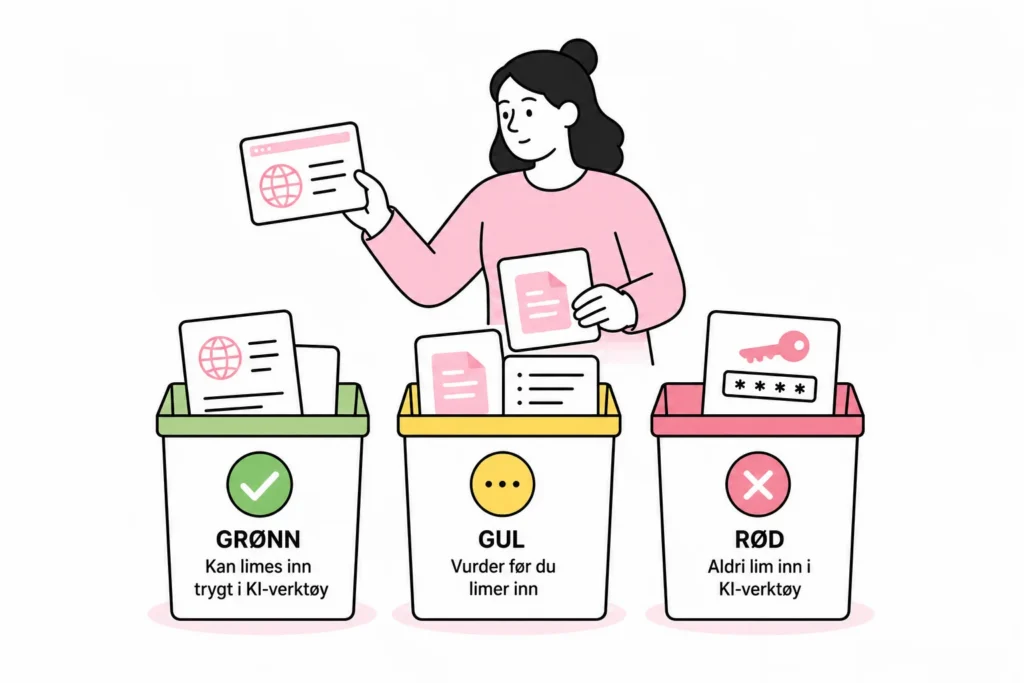
A short classification model is easier to follow than a document that requires its own table of contents. The rules should be adapted to the organisation, but a practical starting point can be green, yellow and red information.
- Green: Public information, general idea drafts and content the organisation has already published. This can be used in approved AI tools, as long as the task is otherwise lawful and relevant.
- Yellow: Internal working material without sensitive personal data or significant confidentiality. This can be used in specific business tools if storage, model training and access have been clarified.
- Red: Secrets, access credentials, sensitive personal data, confidential customer data and information subject to strict contractual or legal requirements. Such information must not be shared with AI unless a dedicated solution and process have been approved.
Add specific examples from your own organisation under each colour. Developers need to know about source code and logs. HR needs rules for applications, performance reviews and sick leave. Sales needs examples related to proposals, customer lists and meeting recordings. “Do not share sensitive information” is correct, but about as actionable as a sign saying “be careful” next to an electrical switchboard.
It should also specify which tools are approved for each category. A tool may be approved for public text but not for customer information. Approval should therefore be linked to the use case and data type, not just the product name.
Make safe use easier than the workarounds
An AI policy only works if employees have a practical alternative. If the approval process involves five forms and the next meeting of the AI committee is six weeks away, someone will sooner or later use a private account to get the job done. The process will then have achieved the opposite of its purpose, though surely in a very orderly way.
The organisation should therefore establish a few clear measures:
- Make a short list of approved tools and use cases. Describe what the tools can be used for and which data is prohibited.
- Use organization-managed accounts. Enable centralized login, multifactor authentication and role-based access where available.
- Configure the data controls. Consider retention periods, history, sharing, integrations and the use of data for model improvement.
- Give employees safe prompt templates. Show how names and identifying details can be replaced with roles, categories or synthetic examples.
- Designate a responsible function. Employees must know who can answer questions and approve new use cases.
- Review regularly. Tools, terms and features change. Otherwise, an annual review cycle is an impressively slow security mechanism for services that can be adopted in minutes.
Technical safeguards can support the rules. Network controls, managed browsers, restrictions on unauthorized extensions and alerts when certain types of data are shared may be appropriate. Such measures must be introduced proportionately and with due regard for privacy and employment law. Nor do they replace training; they merely reduce the number of mistakes that can be made before lunch.
Have a plan for when someone shares too much
Mistakes will happen, even with good rules. Employees should be able to report them quickly without fearing that an honest mistake will be met with a public trial in the calendar invitation. Early reporting gives the organization a better chance to limit the damage and fulfill any applicable obligations.
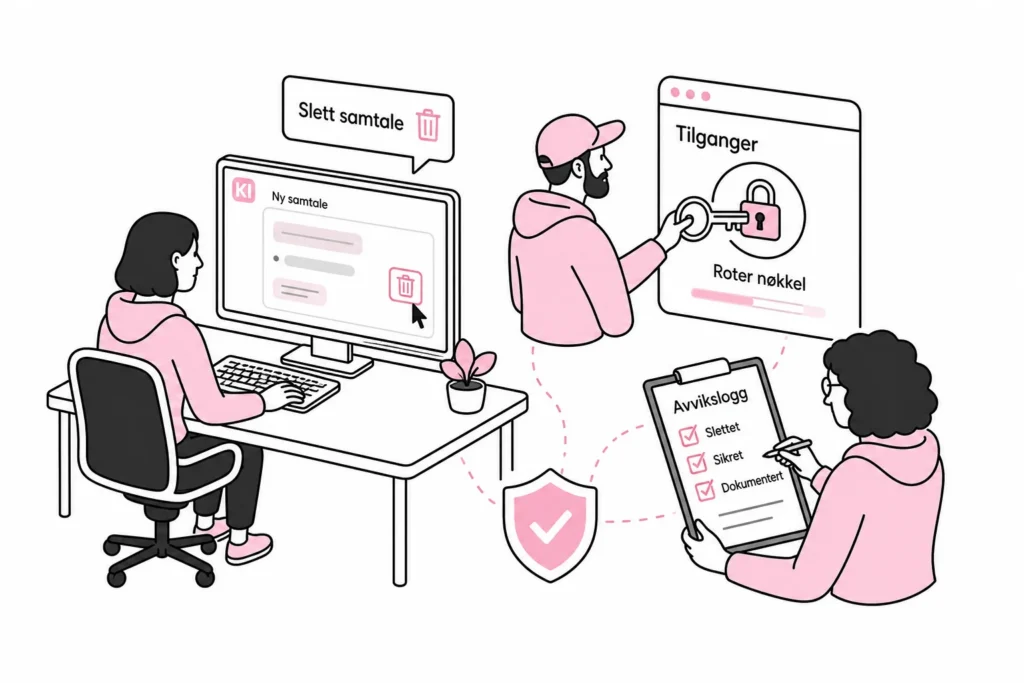
When information has been shared incorrectly, you should document what was sent, which tool and account were used, when it happened and who may be affected. Delete the conversation or file if the service offers a genuine way to do so, and contact the provider if necessary. If passwords, keys or tokens have been shared, they must be revoked and replaced quickly. For personal data, the privacy officer must assess whether the incident requires further action or notification.
The most important thing is to make proper use concrete. Employees should not have to interpret vendor terms every time they want to summarize a document or improve a text. With data classes, approved tools and a quick route to help, AI can be used effectively without the prompt field becoming the organization’s most informal archive system.