
A common SEO question for business websites is whether every service should have its own page. The short answer is: only when the service addresses a clear need that deserves a standalone answer. More pages do not automatically mean greater visibility. Sometimes they simply create more content to maintain—rather like buying more filing cabinets to bring better order to a single document.
Getting the page structure right requires you to consider search intent, information architecture, content and technical SEO together. A service page must be discoverable, understandable and useful. It must also have a clear role on the website, rather than being hidden away like a digital meeting room no one remembers to book.
The goal, therefore, is not to create as many landing pages as possible. The goal is to give every important customer need a good place to land.
Start with search intent, not the service list
A company’s internal structure is rarely a good starting point for SEO. Customers search for problems, needs and deliverables—not necessarily the names in the organisational chart. One department may provide five services with completely different search intents. At the same time, three internal product names may effectively address the same need.
A dedicated page usually makes sense when users expect a standalone answer. For example, an accounting firm could have separate pages for payroll processing, annual accounts and ongoing accounting. The services involve different questions, decision criteria and next steps. By contrast, “accounting assistance” and “help with accounting” do not need separate pages simply because a keyword tool displays two rows in a spreadsheet.
Assess each potential service page using these questions:
- Does the need have its own search intent? The user is trying to solve a specific task, not merely find a synonym.
- Can the page provide standalone, useful content? You should be able to explain the deliverable, target audience, process, limitations and next steps without copying other pages.
- Does the service have clear business value? The page should support a service you genuinely want enquiries about.
- Can you offer a relevant action? This could be requesting an assessment, booking a meeting, sending an enquiry or moving on to a more specific service.
- Will the page still be useful in a year? A stable page is generally more valuable than a short-lived version created for a single phrasing.
If the answers are mostly no, the topic should probably be part of a broader service page. An SEO plugin with a green traffic light can help with certain page elements, but it cannot determine the information architecture. That would be like asking the smoke alarm to furnish the house.
Build a structure that shows how things fit together
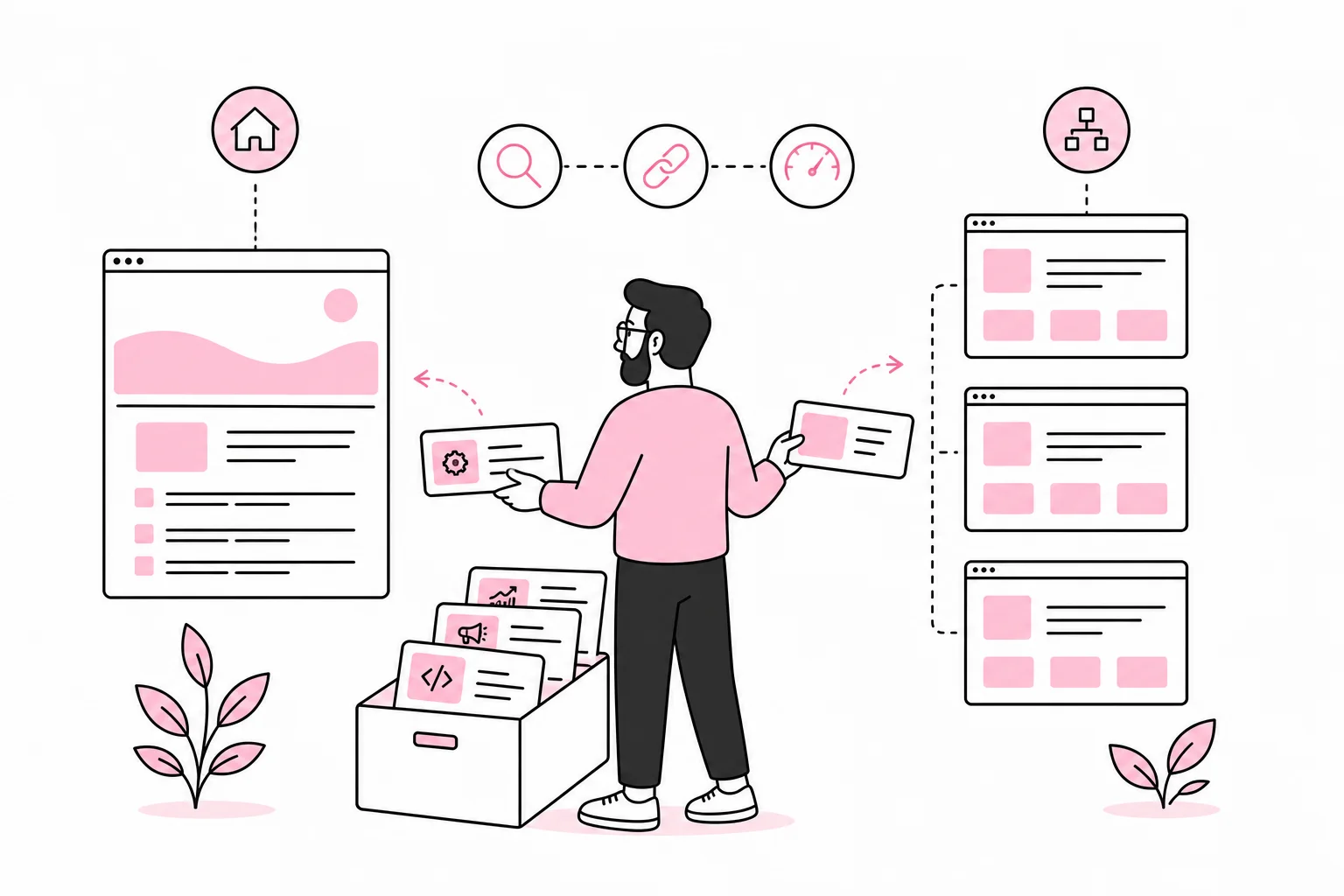
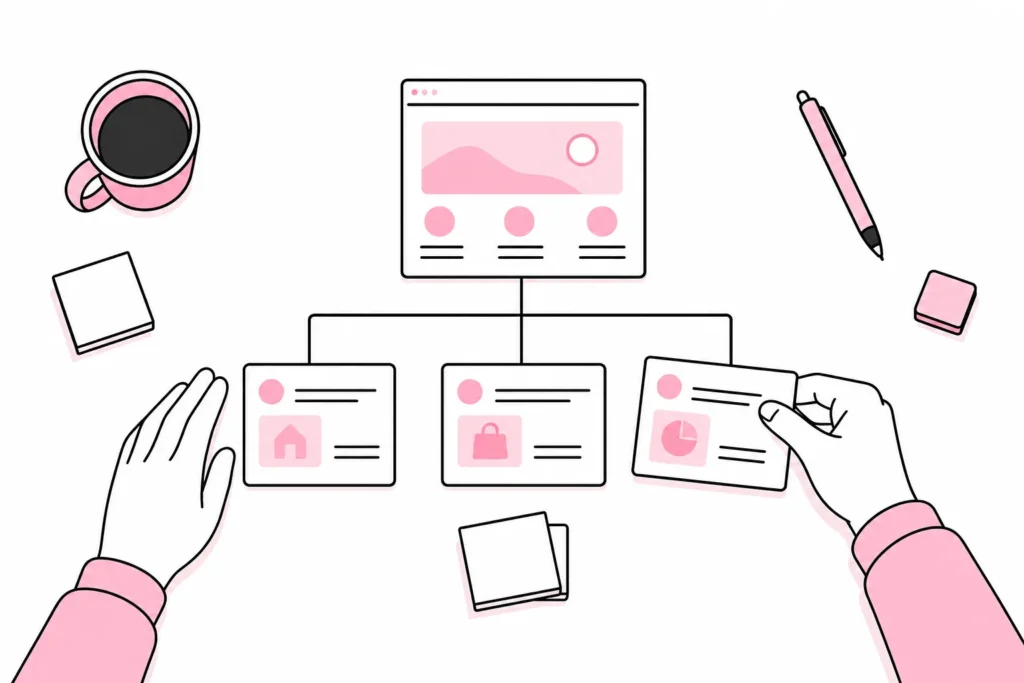
Once you have selected the services, they need to be placed in an understandable structure. For many business websites, a model with an overarching service page and underlying pages for specific deliverables works well. The overarching page explains the field, helps users choose and passes relevance on to the subpages.
The structure should be shallow enough for important pages to be reached without an expedition through the menu. At the same time, it should be precise enough for both users and search engines to understand which pages are overarching, which are specialised and how they relate to one another.
Use internal links as signposts
Internal linking is not about forcing in as many links as possible. A good internal link explains what the reader can do next. From an accounting page, you can link to payroll processing when the text mentions employer responsibilities. From the payroll page, you can link back to the overall service overview for users who need a broader service.
Use descriptive anchor text that says what the destination page is about. “Read more” is not forbidden, but it is not very informative when it appears six times on the same page. Menus should not reproduce the entire organisational chart with every internal area of expertise, either. It is impressive in roughly the same way as a three-metre-long receipt.
Prioritise internal links from:
- overarching service pages to specialised subpages
- relevant expert articles to the service that solves the problem
- related services that are often purchased or considered together
- important pages with high visibility to pages you want to promote
Check the technical foundation
A well-written service page is of little help if it cannot be indexed, has no internal links or points to another page as the preferred version. Check that the page is accessible to search engines, has the correct canonical designation, is included in the website’s sitemap and does not compete with nearly identical variants.
Avoid orphaned pages that exist only in the sitemap or in a campaign you ended long ago. Search engines use a website’s link structure to understand priority and context. If no relevant pages point to a service, you are also sending a fairly clear signal that it is not particularly important.
Create content that helps users choose
A service page should not merely confirm that the service exists. It should reduce uncertainty before an enquiry. Explain who the service is suitable for, what problem it solves, what the deliverable includes, how the collaboration works and which factors affect price or timing.
A useful service page can be structured around this sequence:
- Clear introduction: Describe the service and target audience in concrete terms.
- The problem being solved: Show that you understand the situation the user is facing.
- The deliverable: Explain what the customer actually receives and what, if anything, is not included.
- The approach: Make the process understandable without wrapping a simple delivery in seven “transformative phases”.
- Documentation: Use relevant examples, expertise, work samples or concrete results you can stand behind.
- Next step: Give the user an action that matches their decision stage.
Don’t create forty nearly identical pages where only the service or place name has been changed. A “magic” content generator can produce them before lunch, but the magic looks more like cloning a consultant and swapping the nameplate. You end up with many pages without making the site more useful.

Also adapt the format to the intent. A user considering a complex B2B service often needs more thorough explanations than a user looking for a narrowly defined standard service. The length should be determined by what needs to be explained, not by a fixed word count from an SEO tool.
Let Core Web Vitals support the page, not sabotage it
Core Web Vitals measure key aspects of perceived performance: how quickly the main content appears, how responsive the page is during interaction, and whether elements shift as the page loads. This is particularly important on service pages, because they often combine large hero images, forms, tracking scripts, animations and content from multiple systems.
Start with the page template, not just the individual page. Optimise the main image, use the right image sizes, limit unnecessary JavaScript and make sure fonts and media elements do not cause layout shifts. Test on both mobile and larger screens. A performance plugin can be useful, but five performance plugins are usually an advanced way to let several mechanics work on the same wheel at once.
Pay particular attention to the element displayed at the top of the page. A heavy background video may look great on the office’s fast network, but the user probably came to understand the service, not to watch a short film about people pointing at glass walls.
Publish fewer pages, and monitor them more closely
Once the page is published, monitor which searches it appears for, whether users continue to other pages, and whether it generates relevant enquiries. Also look for cases where multiple pages gain visibility for the same search intent. This may mean that the structure is unclear or that the content overlaps.
If two pages address the same need, consider consolidating the content on the stronger page. Move over what is genuinely useful, redirect the redundant page and update internal links. If the intents are different, make the distinction clearer through the title, main content, examples and next steps.
The practical rule of thumb is simple: Create a dedicated service page when it represents a distinct customer intent, can provide a self-contained answer and has a clear place in the website. Then ensure good internal linking, technical accessibility, fast loading and content that helps the user make a decision. This results in fewer random pages to maintain and a website that is easier to understand. For people too, who are still quite a central target audience.