
An AI agent is software that can interpret a goal, choose actions and use other systems to complete a task. That sounds appealing, especially now that almost anything involving a language model and access to a calendar gets labelled an “agent”. With a little generous marketing, even the stapler will soon be a strategic adviser.
The specific question, therefore, is not whether AI agents are exciting, but whether your business has a task that genuinely requires this degree of autonomy. Many processes become cheaper, safer and easier to maintain with conventional automation. Other tasks involve so much unstructured information and variation that an agent may be useful.
The choice should be based on the task, not the product name. Here’s a practical method for distinguishing between the need for an AI agent, a traditional workflow and a combination of the two.
What distinguishes an AI agent from conventional automation?
Conventional automation follows predefined rules. When a form is submitted, the system can check required fields, create a case, send a confirmation and notify the relevant department. The same input will normally follow the same process.
An AI agent has more room to act. For example, it can read an unstructured customer enquiry, determine what the customer is trying to achieve, retrieve relevant information from several systems and suggest or perform the next action. The agent uses a language model to assess the situation as it goes, rather than simply following fixed conditions.
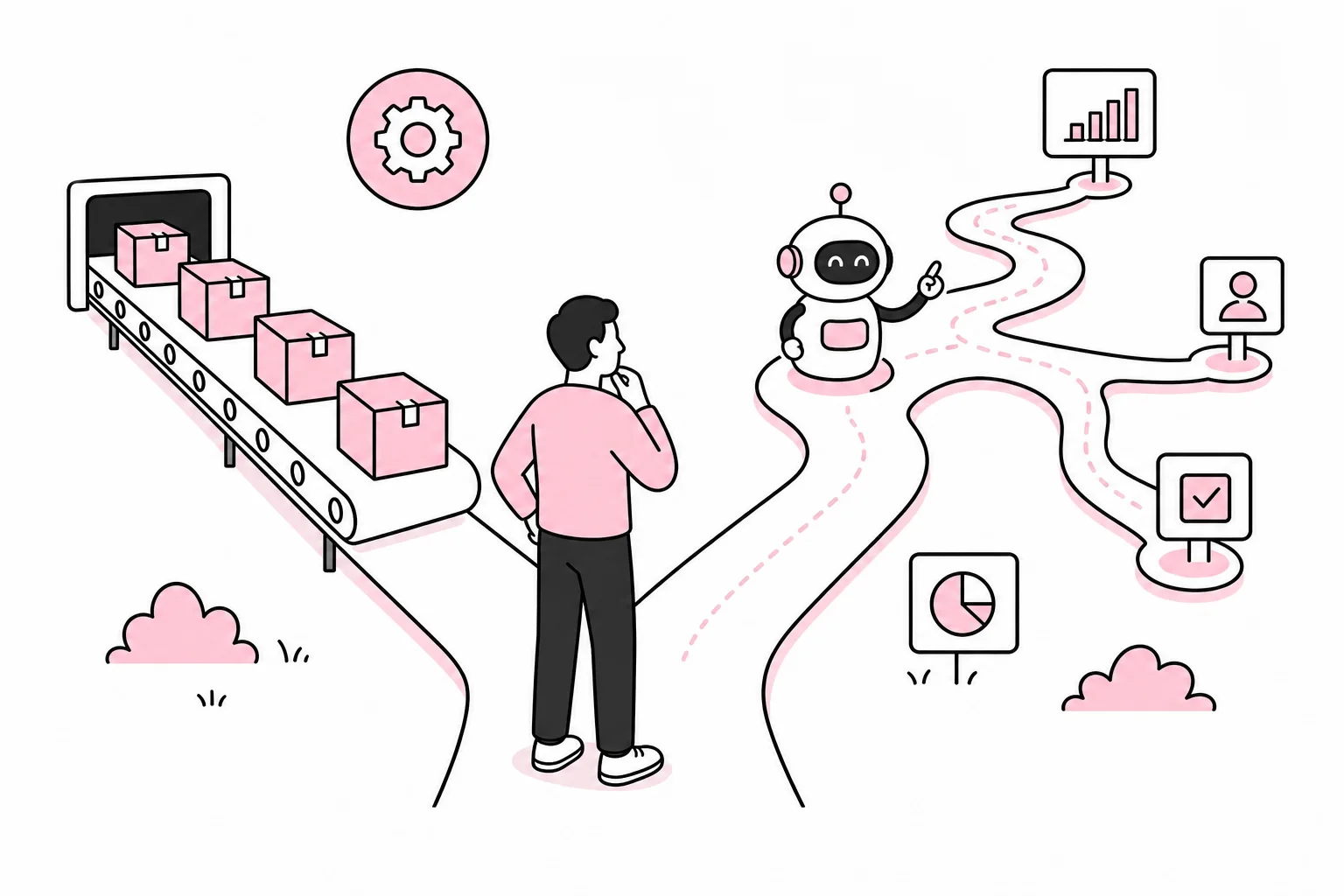
The difference can be compared to a railway and a taxi. A traditional workflow runs on rails: highly predictable and efficient as long as the destinations are known. An agent is a taxi that can choose a route when the road is closed. This provides flexibility, but you also have to trust the driver’s judgment, the map data and access to the vehicle.
An agent is therefore not automatically better automation. It introduces variation, more difficult testing and more decisions that must be controllable. A “magic agent plugin” promising to automate the entire business before lunch is usually just a language model with system access and an impressive number of gradient-coloured boxes.
Four questions that reveal what you need
1. Is the task predictable?
Start by mapping how many valid paths the task can take. If the rules are stable and can be expressed clearly, you should normally choose conventional automation. Price calculations, field validation, order transfers and sending standard notifications rarely need an agent.
An agent becomes more relevant when the input varies widely, the information mainly consists of free text, or the right next step depends on context. One example might be sorting lengthy supplier enquiries, extracting contractual points and suggesting who should handle the case.
2. How serious is an erroneous action?
Distinguish between suggesting and executing. An agent that drafts a reply has less serious consequences than an agent that sends the reply, changes a customer agreement or refunds money. The greater the consequences, the clearer the approval, access restrictions and controls should be.
For tasks with financial, legal or security implications, the agent should normally operate within narrow boundaries. It can gather information and suggest the next step, while a person approves the action. Full autonomy is not a mark of quality. Sometimes it simply means the error has more time to work undisturbed.
3. Does the solution need to use multiple systems?
Agents are often presented as useful because they can use email, CRM, case-management systems and internal knowledge sources. That may be true, but each integration also expands the area where something can go wrong. The agent needs authentication, restricted permissions, stable interfaces and a clear understanding of which data it is allowed to process.
If the task is simply to move a defined dataset from one system to another, a conventional integration is usually better. If the agent must interpret the content, investigate multiple sources and choose between different actions, agent functionality may make sense.
4. Can you describe a good result?
An agent should not be given a vague goal such as “improve the customer journey”. Instead, describe exactly what it should deliver: classify the enquiry, find the customer, retrieve the three latest cases and suggest the right queue. That makes the result testable.
If no one can explain what a good answer or correct action looks like, the process is not ready for autonomy. Setting three agents to discuss the ambiguity among themselves primarily creates a digital status meeting.
Choose a hybrid before choosing full autonomy
For many businesses, a hybrid is the most robust solution. Use fixed rules where the requirements are clear, and use AI only in the steps that require interpretation. This limits uncertainty without removing the benefits.
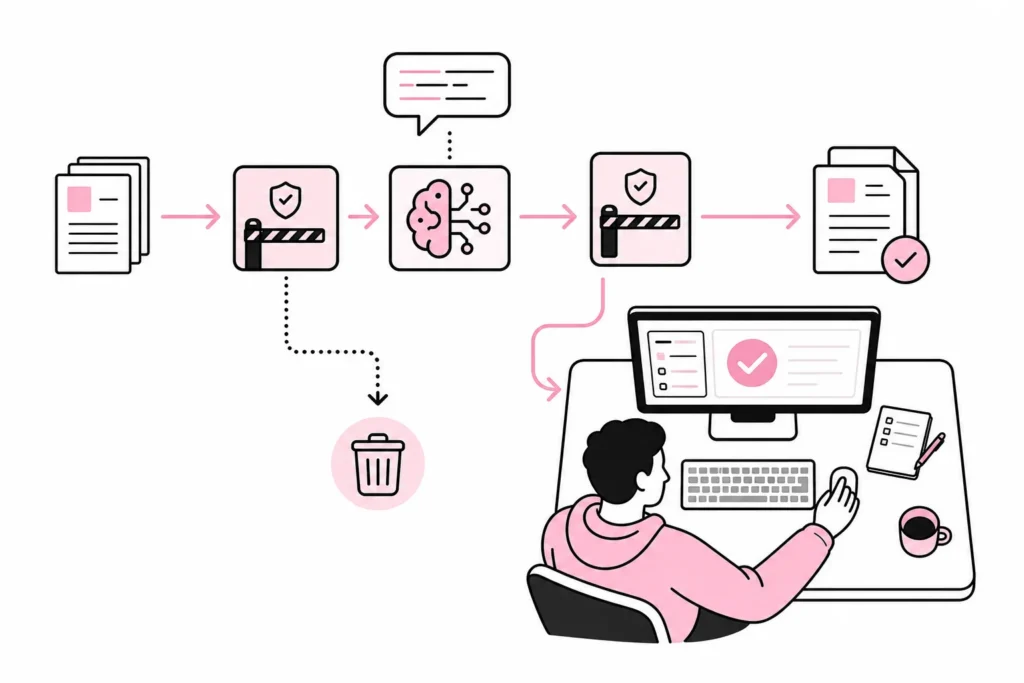
A solution for handling customer enquiries could, for example, be built as follows:
- A standard system receives the enquiry and records the time, sender and consents.
- A language model suggests a category, priority and brief summary.
- Fixed rules determine which categories the agent may work on further.
- The agent retrieves relevant customer information with read-only access.
- The agent drafts a reply or suggests the next action.
- An employee approves actions that affect the customer, finances or agreements.
- The system logs the basis, outcome and person who approved it.
This structure makes it possible to test the AI step separately. It also prevents a creative interpretation from moving unchecked through the entire system landscape. Traditional program logic is not particularly fashionable, but it shows up precisely every day and rarely requires a new strategic name.

How to test an AI agent on a small scale
Start with one narrowly defined task, not an entire department. Choose a process with enough volume for the benefits to be measured, but low enough risk for errors to be detected and corrected. It is often useful to run the solution in observation mode first, with the agent suggesting actions without executing them.
The test should include normal cases, incomplete cases, ambiguous wording and attempts to get the agent to break its instructions. Use real examples only if the legal basis for processing, data minimisation and access control have been clarified. Otherwise, the material should be anonymised or replaced with representative test data.
Define the metrics before the pilot begins:
- Quality: How often are the classification, suggestion or action correct?
- Time spent: How much work does the solution save when review time is included?
- Exceptions: What errors occur, and how serious are they?
- Predictability: Do similar cases produce consistent results?
- Cost: What do model usage, integrations, monitoring and maintenance cost?
- Traceability: Can you see which data and rules underpinned the action?
Give the agent the fewest possible permissions. Read access should be assessed separately from write access, and critical actions should require approval. You also need limits on the number of steps, time spent and cost per task. An agent that cannot find the answer should be able to stop and pass the case on. The big red stop button remains one of the more underrated innovations in the history of technology.
Also plan for change. Instructions, models, integrations and data sources can affect the results. The solution should therefore include version-controlled instructions, fixed test sets, event logs and a named owner responsible for following up on quality and deviations.
The rule of thumb is simple: Choose conventional automation when the process can be described using stable rules. Consider an AI agent when the task requires interpretation, context and a choice between several defensible actions. Choose a hybrid when some steps require judgment, while the rest should be predictable.
The best solution is rarely the one that appears most autonomous in a demonstration. It is the one that solves a specific task, can be controlled by people and remains understandable six months later. If the vendor needs forty slides to explain who approves an action, the agent has probably automated the wrong part of the process.